


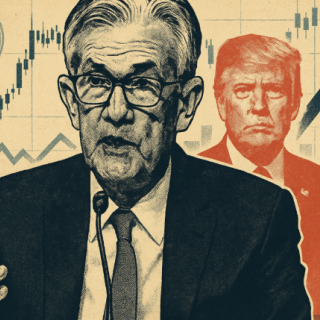
Federal Reserve Chair Jerome Powell on Tuesday delivers his last scheduled remarks before the Fed's next meeting with the economy enjoying stronger-than-expected growth and a recent jump in productivity, but still adjusting to tariff and immigration policies that economists worry could lead to both higher inflation and higher unemployment.
Challenging for a central bank responsible for keeping inflation low and employment as high as possible, Powell and his colleagues are also facing a drought of official data amid a U.S. government shutdown that has delayed the September jobs report and other key statistics. An update on consumer prices is now scheduled for October 24, before the Fed's October 28-29 meeting.
Investors expect the Fed to lower its benchmark interest rate by a quarter-of-a-percentage point to the 3.75%-to-4.00% range, and then lower it again in December.
But the competing forces in the economy right now have become tangled, said EY-Parthenon Chief Economist Gregory Daco.
"There are conflicting forces that are affecting the US economy, in particular, with the US economy essentially being constrained by tariffs...Also by reduced immigration," Daco said at a meeting of the National Association for Business Economics conference, where Powell speaks on Tuesday. "At the same time, we're seeing a great deal of investment on the AI front These forces are offsetting one another, not necessarily proportionally, not necessarily at the same time, but I think it's a very interesting duel."
How fast the tension resolves into a more consistent view of the economy will be crucial for coming Fed decisions.
Policymakers are divided between those concerned that inflation remains above the Fed's 2% target and is expected to remain so through next year, and those who see the job market at risk of a fast slide.
"Something's got to give," Fed Governor Christopher Waller told CNBC last week. He noted the contradiction between economic growth estimates getting revised higher - nearing 4% for the third quarter, according to the Atlanta Fed's GDPNow model - and a job market that seems in the doldrums with a recent report from payroll processor ADP showing the economy lost jobs in September.
"You can't have negative job growth and 4% GDP growth....Either the labor market rebounds to match the GDP growth, or GDP growth is going to pull back," said Waller, who favors further rate cuts to protect the job market, but says those should come in cautious, quarter-point moves to avoid a mistake.
The Fed's quarter-point reduction in September was framed as a way to balance potential strains on the job market while still leaving rates high enough to maintain downward pressure on inflation.
In the absence of the September jobs report, officials like Waller have noted that an array of private-sector indicators have pointed to weak hiring, even if none on their own is a perfect substitute for the Bureau of Labor Statistics' monthly surveys of businesses and households.
Source: Investing.com
Stephen Miran, a Federal Reserve governor whose term ends at the end of January, said Thursday that he is looking for 150 basis points of interest-rate cuts this year to boost the U.S. labor market. ...
Federal Reserve Vice Chair for Supervision Michelle Bowman outlined significant changes to bank supervision and regulation during a speech at the California Bankers Association Bank Presidents Seminar...
Further changes to the Federal Reserve's short-term interest rate will need to be "finely tuned" to incoming data given the risks to both the U.S. central bank's employment and inflation goals, Richmo...
Richmond Federal Reserve Bank President Tom Barkin said the monetary policy outlook remains in a fragile balance given the conflicting pressures of rising unemployment and persistently high inflation....
The US Federal Reserve agreed to cut interest rates at its December meeting only after a highly nuanced debate about the current risks facing the US economy, according to minutes from the two-day meet...
Oil prices stabilized on Thursday (February 12th), as the market reassigned a risk premium to US-Iran tensions despite US inventory data showing swelling domestic supplies. This movement confirms one thing: geopolitical headlines are still more...
Gold prices weakened slightly on Thursday (February 12th), as more solid US employment data reduced market confidence in an imminent Federal Reserve interest rate cut. The strong employment data prompted market participants to shift expectations of...
The Hang Seng Index reversed its downward trend in Hong Kong on Thursday (February 12th), weakening by around 0.9% to around 27,000 after a strong session earlier. This decline halted the momentum of the short term rally, as investors began to...